
You’ll make one of the most critical decisions for your South African business when you choose between operating as a sole proprietor or registering as a Pty Ltd. A sole proprietorship in South Africa is the simplest business structure to start, but it comes with personal liability and tax rates that range from 18% to 45% depending on your income bracket. Pty Ltd companies are taxed at a flat corporate rate of 27%, but they involve additional compliance costs and dividend taxes. The sole proprietor vs pty ltd decision hinges on your income level and risk tolerance. In this piece, we’ll break down the tax implications at different income levels and help you determine which structure saves you more money over time.
Understanding Sole Proprietorship vs Pty Ltd in South Africa

What is a Sole Proprietorship in South Africa
A sole proprietorship is a business owned and operated by a natural person. It represents the simplest form of business entity. The business has no existence separate from the owner. You and your business are one entity. You can operate under your own name or use a fictitious trade name without creating a separate legal entity. Sole proprietors don’t need to register with the Companies and Intellectual Property Commission (CIPC).
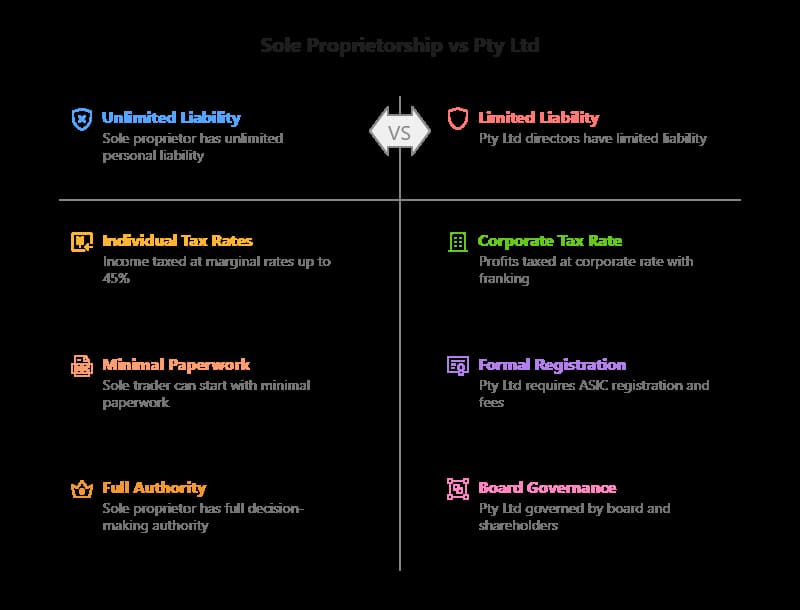
The owner retains control over business decisions and receives all profits. But this structure comes with unlimited liability. You’re personally responsible for all business debts. Creditors can seize your personal assets to settle business obligations. This includes your home, savings and investments.
What is a Pty Ltd Company
A Pty Ltd (Proprietary Limited) is the most common business structure in South Africa. It’s recognized as a separate legal entity distinct from its shareholders and directors. The company can own property, sign contracts and operate in its own name. A Pty Ltd requires at least one director and one shareholder. , plus R50 to reserve a name.CIPC registration costs R475
Key Legal and Structural Differences
The sole proprietorship operates under common law with minimal legal requirements. Pty Ltd companies are governed by the Companies Act 71 of 2008. Sole proprietorships can be set up with identification and proof of business address. Pty Ltd registration takes 1-2 weeks and requires a Memorandum of Incorporation.
Liability Protection: Personal vs Limited
stands as the defining advantage of a Pty Ltd structure. Shareholders’ liability is limited to their investment amount. This protects personal assets from company debts. Sole proprietors face unlimited personal liability. All personal and business assets are exposed to creditor claims. The “corporate veil” shields Pty Ltd directors from personal responsibility of company liabilities. Courts can pierce this veil under circumstances with unconscionable abuse.Limited liability protection
Tax Implications: Sole Proprietor vs Pty Ltd Breakdown
How Sole Proprietors Are Taxed (Progressive Rates 18%-45%)
Sole proprietors report business income on their personal income tax returns. Profits get taxed at . SARS treats you and your business as the same person. All business earnings merge with other personal income (salary, rental, interest) and get taxed together. Your marginal tax rate depends on total taxable income. Higher profits push you into steeper brackets. The 2026-2027 tax year applies these rates across seven income bands. The first band starts at 18% if you have income up to R245,100. The top 45% bracket kicks in when income exceeds R1,878,600.progressive individual rates from 18% to 45%
How Pty Ltd Companies Are Taxed (27% Corporate + 20% Dividends)
Companies face a on taxable income for years ending between April 2026 and March 2027. This creates a two-tier tax structure. The company pays 27% on profits first, then shareholders pay 20% dividends tax when extracting those profits. Dividends between South African resident companies are exempt from dividends tax and offer planning opportunities for group structures.flat corporate income tax rate of 27%
VAT Registration Requirements for Both Structures
Businesses exceeding R1 million in turnover during any consecutive 12-month period must register for VAT. Sole proprietors and Pty Ltd companies follow similar VAT thresholds. Voluntary registration is available to businesses with turnover between R50,000 and R1 million. VAT-registered entities charge 15% on taxable supplies and can claim input tax credits.
PAYE and Provisional Tax Obligations
Companies register for provisional tax upon corporate income tax registration. Sole proprietors earning income beyond salary must register for provisional tax on their own. Both structures submit IRP6 returns twice yearly. First payment is due six months after year-end start, and second payment is due at year-end. Businesses with employees must register for PAYE whatever the structure.
Tax Returns and Filing Requirements
Sole proprietors file annual ITR12 returns (for individuals) and declare business income with personal income. Companies submit ITR14 returns within 12 months of financial year-end. Sole proprietors also complete two IRP6 provisional tax returns each year. Companies handle provisional tax through their corporate registration.
Tax Calculations: Which Structure Saves You More at Different Income Levels
Tax Comparison at R100,000 Annual Income
A sole proprietor demonstrates lower tax liability than a Pty Ltd structure at R100,000 profit. The sole proprietor faces a much lower effective tax rate compared to a company on similar taxable income. This occurs because R100,000 falls within the lower individual tax brackets, where rates start at 18% on the first R245,100.
Tax Comparison at R500,000 Annual Income
But income levels around R500,000 move the calculation dynamics. A sole proprietor at this level encounters progressive rates climbing to 31% on income above R383,100. Meanwhile, a Pty Ltd operating as a Small Business Corporation pays R18,848 plus 21% on taxable income between R365,001 and R550,000.
Tax Comparison at R1,000,000+ Annual Income
The Pty Ltd advantage crystallizes when profits reach R1 million. The sole proprietor’s at this threshold, while the sole shareholder of a Pty Ltd maintains an effective rate of 41.6%. But the company structure provides flexibility in timing dividend withdrawals and defers personal tax obligations.effective tax rate increases to 29.23%
The Break-Even Point: When Pty Ltd Becomes More Tax Efficient
The break-even point emerges between R500,000 and R1,000,000 annual profit. Higher marginal individual rates push sole proprietors into less favorable territory at R1 million, making incorporation worth thinking about for businesses that exceed this threshold consistently.
Beyond Tax: Setup Costs, Compliance and Long-Term Considerations
Original Registration Costs and Timeframes
Setting up a sole proprietorship in South Africa involves virtually no registration costs since you don’t register with CIPC. You need certified ID copies and proof of address for SARS registration. including name reservation, or R125 without a name. Online name reservation through CIPC costs R50. The registration turnaround takes about one day for simple packages, though some processes extend to seven working days.Pty Ltd registration costs R175
Annual Compliance Requirements and Costs
Companies must file annual returns with CIPC and maintain detailed financial records for at least seven years. All companies require an accounting officer to prepare financial statements. Audited financial statements may be necessary depending on turnover. Sole proprietors face simpler compliance, though banks still require financial statements for loan applications.
Access to Funding and Business Credibility
Registered entities can access business loans. Banks are more willing to extend capital funding to Pty Ltd companies with proven track records. A registered company appears more professional and trustworthy, which benefits investor negotiations.
Switching From Sole Proprietor to Pty Ltd: When and How
Conversion becomes worthwhile once . The process involves reserving a company name, registering with CIPC using CoR 15.1A or CoR 15.1B forms, and registering for tax with SARS. Deregistering the sole proprietorship is optional but reduces administrative confusion.revenue crosses R660,000
Comparison Table: Sole Proprietor vs Pty Ltd in South Africa
| Attribute | Sole Proprietorship | Pty Ltd Company |
| Legal Status | No separate legal entity; owner and business are legally one | Separate legal entity distinct from shareholders and directors |
| Registration with CIPC | Not required | Required |
| Setup Costs | Virtually no registration costs | R175 (including name reservation) or R125 (without name); R50 for name reservation |
| Registration Timeframe | Instant (with ID and proof of address) | 1-2 weeks; about 1-7 working days based on process |
| Governing Law | Common law with minimal legal requirements | Companies Act 71 of 2008 |
| Liability Protection | Unlimited personal liability; creditor claims expose personal assets | Limited liability; shareholders’ liability limited to investment amount |
| Tax Rate Structure | Progressive individual rates: 18% to 45% based on income brackets | Flat corporate rate: 27% + 20% dividends tax on profit distribution |
| Tax Rate at R100,000 Income | Lower effective tax rate (starts at 18% bracket) | Higher effective tax rate at this income level |
| Tax Rate at R1,000,000 Income | Effective rate: 29.23% | Effective rate: 41.6% (including dividend tax) |
| Tax Break-Even Point | Less tax efficient above R500,000-R1,000,000 | More tax efficient above R500,000-R1,000,000 |
| Tax Filing | ITR12 (individual returns) + IRP6 (provisional tax, twice yearly) | ITR14 (corporate returns) + automatic provisional tax registration |
| VAT Registration Threshold | Mandatory above R1 million turnover; voluntary between R50,000-R1 million | Mandatory above R1 million turnover; voluntary between R50,000-R1 million |
| PAYE Registration | Required if the business has employees | Required if the business has employees |
| Annual Compliance | Simpler compliance; financial statements needed for bank loans | Must file annual returns with CIPC; maintain financial records for 7+ years; requires accounting officer |
| Financial Statements | Required by banks for loan applications | Required; may need audited statements based on turnover |
| Access to Funding | Limited; business loans not available | Better access; banks more willing to extend capital funding |
| Business Credibility | Less formal appearance | More professional and trustworthy appearance to investors |
| Conversion Threshold | Think about converting when revenue crosses R660,000 | N/A |
| Decision Authority | Owner retains complete control; receives all profits directly | Governed by directors and shareholders; formal structure |
Conclusion
The sole proprietor vs Pty Ltd debate doesn’t have a universal winner. If you’re earning under R500,000 annually, a sole proprietorship saves you more tax and keeps compliance simple. Once profits exceed R1 million, a Pty Ltd becomes more tax efficient despite the dual taxation structure.
Think about liability protection, funding access and business credibility beyond tax rates. Your income level and risk tolerance should guide your decision.